1949-11-10 Thunderbolt

Thunderbolt ranks down at the bottom of Casey episodes, along with Great Grandfather's Rent Receipt and Action Photograph. There are elements of 1947-04-24 The Gentle Strangler that are re-used in the story. The plot and the dialogue are lifeless and the mad man who thinks he's Thor is silly and unconvincing. It's disappointing that this episode even made it to the air.

ADC continuity notes...

Dr. Foley, prominent brain surgeon, is found murdered - killed with a small tack hammer. His body is found on a dark street - after a thunderstorm - stretched out under a streetlamp. The previous week, Eli Whitlock, famous playwright, was found dead - under similar circumstances. A third murder is committed - under the same conditions and again, as in the two previous instances, the victim was a prominent, successful member of the community. A letter (the second of its kind) is received at City Desk, giving advance notice that another murder is about to be committed. The writer, who signs himself "Thunderbolt," promises another victim will meet his fate on the next rainy night. He describes his pretty certain intended victim and it's from the description, that be has Casey in mind. The next rainy night finds Casey on his way home - and sure enough he meets up with said murderer. After much struggling - and  some quick thinking on Casey's part, the killer is subdued and Casey has solved another crime.

This is somewhat like Gentle Strangler where people are accosted in the street and attacked. Some of the dialogue with Foley in the street is similar. The victim there was Whitcomb. The previous victim here was Whitlock. Cole is grabbing elements here and there.

2:12 The criminal (named Thorson) says that the thunder reminds him of Thor... get it? He's Thor's son.

A tack hammer was used in the killings. https://en.wikipedia.org/wiki/Upholstery_hammer

Whitlock's alleged killer had been arrested and put in jail. But he never admitted the killing, just going through the pockets of someone already dead. Now, this new killing appeared to exonerate the person jailed.

4:55 Burke appears again. He has a letter from Thor, "his thunderbolt will destroy others." He'll attack again in the next thunderstorm, implying that it will be a financier of some kind.

7:00 Ann and Burke make some fun of Casey for not really knowing the legend Thor.

9:12 Thorson meets Klammert in the street... the attack is not enacted, but the scene changes to Logan's office in the aftermath of the new killing, also with a tack hammer. Thorson is disabling street lights with a BB gun.

12:00 Burke visits Logan -- this is the first time in a surviving recording that Burke and Logan are in the same room! He has another letter from Thunderbolt: the next victim target will be Casey, though not mentioned by name, all of the characteristics fit him and no one else.

15:28 Ann pleads with Casey to drive home and not walk home, and to take other precautions. 16:00 Of course he doesn't listen, and asks the parking attendant to not tell Ann.

16:40 Thunderbolt walks up to Casey as he walks home. 17:10 He says he saw Casey at the police station when he was visiting Sergeant McCloskey. Cole used a similar name for a neighbor of a murder victim, McCluskey, in Murder in Black and White.

17:42 It clicks on Casey when he hears the name "Thorson" that he's with Thunderbolt.

18:35 McCloskey is walking in the street, too, and joins them... saying that Logan asked for extra protection for Casey. Carl Thorson excuses himself.

20:35 Casey is in his apartment and the phone is ringing. It's Ann checking up on him as planned, a few minutes late.

21:28 Logan calls and checks on Casey... Thorson has walked through Casey's unlocked door! "You can see I'm armed with a revolver." Just like Gentle Strangler, Casey is confronted with a killer in his very own apartment. Thorson says he will throw his hammer at Casey.

23:35 Casey calls Logan to come and collect the Thunderbolt killer. The dialogue is very similar to that of Gentle Strangler (starting at 24:10 of that episode) for the call, except this time Casey speaks directly to Logan. The ending of that story is a bit more complex where here it is abridged.

The AFRS announcement is "This is the United States Armed Forces Radio Service, the voice of information and education." No cast information is given.

Casey 49-11-10 314 Thunderbolt AFRS (ends with This Is the US Armed Forces).mp3
Degoo https://app.degoo.com/share/bNBkIWz9zp9dWq
hubiC http://ovh.to/1E87S9H

There are no meaningful newspaper clippings for this episode. These are some other items of interest.

1949-11-09 Cincinnati OH Enquirer
Casey, Crime Photographer - Page 6 1949-191

1949-11-10 Scranton PA Times-Tribune
Casey, Crime Photographer - Page 6 1949-190

1949-10-20 The Coffin

The Coffin is a better than average episode, and yet another one where the primary murderer is a woman... Toni would have never gone for that! It is an unlikely plot but worthy of some of the better comic book detective stories. For that reason, it is entertaining, but not a top episode.

The main recording is not the best, so two recordings are posted, with the second one processed for the disc scratch and the background noise.

There are no ADC continuity notes... the notebook just skips this episode; there are no newspaper clippings. The decision to use the script may have been made closer to broadcast time than usual.

The episode opens with a great gimmick... gangsters trying to buy a coffin for a rival gang leader who is not yet dead... or sick.

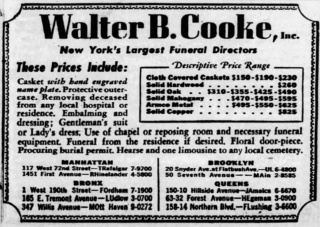
0:50 The gangsters walk into a coffin manufacturer asking to make a purchase. The sales representative says his name is "Cook" or "Cooke." The reason that is "a funny name for a casket salesman" is that the largest funeral home in New York City was  Walter B. Cooke. Cooke was a considered a pioneer in the business.

1949-06-05 NY Daily News
Casey, Crime Photographer - Page 6 1949-189

2:00 Nick Maddock is whom the coffin is being purchased for. Andrew Grollo is the gangster buying it.

3:04 Logan calls the casket a "silver-plated slumber box." Earlier, 1:37 the gangster called it a "plush-lined box."

5:20 Maddock calls Logan asking if they have heard anything; Grollo and his gang walked into the police station! This gives them an alibi for the Maddock killing.

7:38 Casey says that they "may find the point" at Maddock's apartment. He sure does. At 13:01 Casey steps on a thumbtack. Whenever something innocuous and nonsensical happens, Cole has placed it there for a reason.

While Casey and Ann are talking to Inez at Maddock's apartment, she's arguing with Maddock and says she's standing by a doorway. She's putting herself in the right position so as not to get in the way when Maddock gets shot.

10:25 She mentions she grew up in a mill town and that her father was a weaver. That's important later.

10:38 Nick Maddock is shot!

14:02 Officer Bernstein finds fishing line outside, some of it tied in a "sheet bend knot" https://www.animatedknots.com/sheet-bend-knot  It is assumed that whomever killed Maddock was in the Navy at some time.

15:30 At the Blue Note, two weeks have passed without any resolution to the case. Ethelbert says he knows how to make the knot because his mother taught him, except to her, it was called a "weaver's knot."

All of this leads to Casey's theory that Inez, Maddock's girlfriend, created the combination of fishline, thumbtack, and gun, to give her an alibi because she could execute the plan in plain sight of people who would be her alibi. In this case, Casey and Ann. It was also coordinated that Grollo's gang would all be in jail at the time of the shooting. The rope ladder outside the building was used as a decoy.

20:25 Ann turns on the light in Inez' apartment, and Grollo is there looking for evidence, too. 20:54 There's a gun in the room, as Ann says "we're always willing to help a man who has a gun pointed at us." They're all looking for a clamp that held the gun. Grollo says she made him sign an incriminating letter.

22:07 Inez and Grollo shoot each other convinced that one double-crossed the other.

Ann calls Ethelbert a "skinker." The word means "someone who pours liquor." In recent years, there is a vastly different and more obscene definition, which could cleanly be described as a "woman on the prowl for a man." Casey says "skinker" is also a kind of lizard, which is correct. https://en.wikipedia.org/wiki/Skink

The AFRS announcement includes the cast and identifies the network with "This is the United States Armed Forces Radio Service, the voice of information and education."

Here are the two copies, one essentially raw and the other one processed.

Casey 49-10-20 311 The Coffin AFRS#42 UPGRADE.mp3
Degoo https://app.degoo.com/share/21C8KgmZvhJaIi
hubiC http://ovh.to/b2qS8aw

Casey 49-10-20 311 The Coffin AFRS#42 PROCESSED UPGRADE-2.mp3
Degoo https://app.degoo.com/share/obegZaeeU5Ug7d
hubiC http://ovh.to/n3rWUiB
* * * * * * * * * * * * * * * * * * * * * * * * * * * * * *

Since there are no newspaper clippings for this episode, here are some other interesting items

1949-10-26 Hutchinson KS News
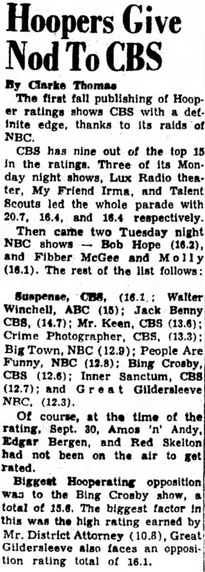
Casey is the 10th highest rated show
Casey, Crime Photographer - Page 6 1949-187

1949-10-26 Visalia CA Times-Delta
Casey, Crime Photographer - Page 6 1949-186

* * * * * * * * * * * * * * * * * * * * * * * * * * * * * *

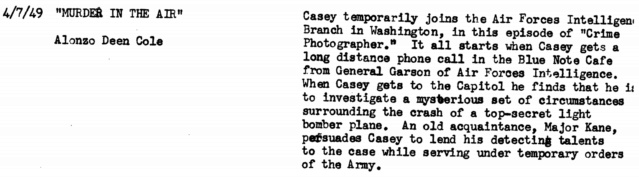
Casey was generally disliked by radio critics, and one of the bigger naysayers was John Crosby, right from the beginning of the series. In this column, he sneers at the series, and by extension, its listeners. He could have, at least, gotten the character names and their spellings correct, but he did not. Since he is critiquing a particular episode, I thought it might be interesting to show the notes from the continuity book that I have been working from. The episode he targets is not in circulation.

Cole's notes for 1949-04-07 Murder in the Air
Casey, Crime Photographer - Page 6 Cole_n10

1949-04-15 Miami FL Herald
Casey, Crime Photographer - Page 6 1949-185

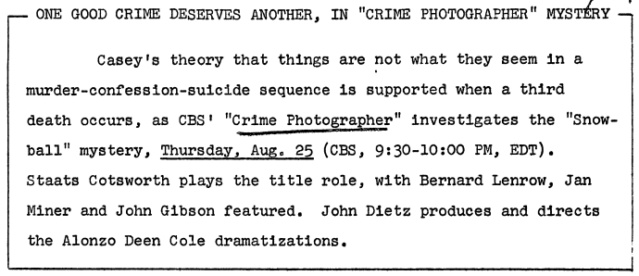
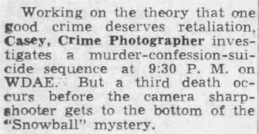
1949-08-25 Snowball

Snowball is a good program despite some really bad acting in an early scene and what seems to be an obvious plot hole. Ignore the bad acting. A little history of automobile technology, something most everyone about cars takes for granted, makes it clear there is no plot hole. It's a reminder that this is old time radio, and though these stories so often transcend their eras, they are still products of their time. The story is one that might never have been broadcast if Toni was still a sponsor. A faked murder-suicide staged by a woman? The idea could make someone's hair curl... without Toni!

The remainder of the Philip Morris episodes are AFRS recordings. They do not have any performance credits; the network recording ends at the end of the Blue Note epilogue, and then immediately cuts to the AFRS identification.

ADC continuity notes...

A murdered woman is found in the back seat of a car driven by an inebriated character who swears he never saw her before. The woman is identified and Casey sets out to question her husband - but finds him dead too, with a suicide note beside the body. It looks like an open and shut case of murder and then suicide born out of an insanely jealous husband's wrath. Neighbors are quick to tell that the dead man was insanely jealous of his beautiful wife who had attracted the attention of her husband's employer, a very handsome and suave ladies man. However, this theory is thrown to the wind when, a short time later, another dead woman is found in the same vicinity as the first. Investigation reveals that jealousy was the motive - but circumstances prove that it was not the husband's jealousy that brought about the triple tragedy - but by another, who, oddly enough, was believed to be out of the country at the time of the catastrophe.

1:49 The drunk's lines "I never saw that woman before" is delivered by the actor so badly, twice. It would be funny if it wasn't so grating.

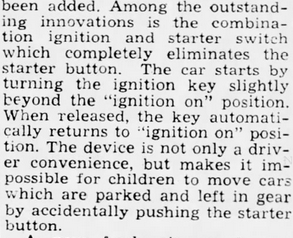
2:45 George P. Rasko pleads his case to Logan... he says he was drunk and got into a car that looked exactly like his. It's a mystery how he got the car to run without his keys. It's not... keys were only needed to lock and unlock cars. The car he mistakenly got into was obviously left unlocked. It was not until Chrysler introduced key ignitions in 1949 that you needed a key to start a car. https://en.wikipedia.org/wiki/Car_key

1949-03-17 Auburn CA Journal
Casey, Crime Photographer - Page 6 1949-184

7:07 They realize the suicide is of James R. Royce, owner of the car that looked like Rosko's, and husband of the strangled woman in the car.

Cole lays some groundwork for the solution to the crime by emphasizing how attractive Mrs. Royce is and how women were jealous of her looks and concerned about her catching the glances of their husbands.

11:12 Casey, Ann, and Logan visit Carlton Judd, Royce's boss. He was expecting Royce, but he never came. Judd's wife went to California, and the servants the Judds had in the house were all off for the night. Royce had a key to the apartment. Judd says he was out at a movie Lost Boundaries at the Empire Theater. It was a real movie https://www.imdb.com/title/tt0041600 and was a highly regarded (Cannes award) film about race relations. https://en.wikipedia.org/wiki/Lost_Boundaries  For what seems to be an unprovoked reason, Casey asks if the apartments are soundproof, and Judd says no. Cole obviously plants that in the story because has a plan to use that as a factor in the conclusion.

15:30 Ann takes a call at the Blue Note that a woman's body has been found at the same apartment building. The medical examiner at the scene says the woman, a servant, was dead prior to being thrown from a top floor apartment.

17:25 Now we know the reason for the title. Casey explains how the first murder kept growing and growing like a snowball going down a hill into another murder involving other people in the building.

18:35 Casey starts figuring out the case... while confronting Judd. Mrs. Royce was killed in Judd's apartment and her body brought down to the car parked in the street, but it was the wrong car. It had to be arranged to make it look like Royce killed his own wife, and then committed suicide.

20:50 Judd confesses... Casey doesn't accept it... Judd's wife is not in California. She's been hiding in the apartment next door. This is why Cole planted the "thin walls" that she could hear her husband confess to the crime. Her trip was faked so she could spy on her husband to see if he was cheating on her with Mrs. Royce.

1949-08-17 CBS Press Release
Casey, Crime Photographer - Page 6 1949-182

This script is unlikely to have been accepted by the Toni management and their ad agency as the three-time murderer of this episode is a woman. It's an indication of how the show changed under Philip Morris.

The AFRS identification is "This is the United States Armed Forces Radio Service, the voice of information and education." Sometimes the identification is useful for identifying which repeated Casey broadcasts are from which years.

Casey 49-08-25 303 Snowball AFRS#36 UPGRADE.mp3
Degoo https://app.degoo.com/share/5dszJxOVeHRNQe
hubiC http://ovh.to/uLdW8xC

1949-08-25 Tampa FL Times
Casey, Crime Photographer - Page 6 1949-183

* * * * * * * * * * * * * * * * * * * * * * * * * * * *

These are interesting items about the show that appeared in newspapers around this time.

1949-08-13 Binghamton NY Press & Sun-Bulletin
Casey, Crime Photographer - Page 6 1949-180

1949-08-14 Sioux City IA Journal
Casey, Crime Photographer - Page 6 1949-181

1949-08-11 The Death of a Stranger

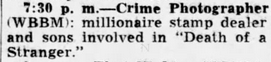
Death of a Stranger is a good Casey episode that draws from real-life aspects of stamp collecting as an element of the crime. The hobby was very popular in the 1930s, 1940s, and 1950s. FDR was known as a stamp collector, and the hobby grew as a way to pass the time during WW2. It's a good story, but it's easy to lose track of, but worth sticking with.

ADC continuity notes...
Millionaire Robert Heiden, dealer in rare stamps refuses to see an elderly gentleman who calls to offer a "three skilling orange error," a Swedish stamp. Knowing the only one of its kind belongs to an ex-King, Mr. Heiden assumed the man was an imposter.  A few minutes later, Heiden's son, Arthur, discovers the man in the reception room, dead.  Capt. Logan responds to a reported "suicide" call but declares the unidentified man has been murdered -- that the throat-cutting could not be self-inflicted.  Casey takes a picture.  After questioning Heiden's secretary and his two sons, the case seems stymied because no one recognizes the stranger. Casey shows the picture to Ethelbert who recognizes the murdered man as Angelo Carfora and tells Casey where he lives. Ann and Casey set off to investigate without informing Logan.  As they approach the house, an explosion is heard from within Carfora's house, flames follow and a man dashes from the house. In the darkness, the fleeing man shoots Casey's flashlight from his hand, slugs Ann and Casey.  They recover as the Fire Dept. is arriving.  Ann stumbles on a gun which police trace by seria1 number and report a permit for same was issued in the name of Arthur Heiden.  Now Casey and Logan and Ann return to the Heiden home to question the elder Heiden again, having learned that Carfora was also a stamp collector.  In the midst of this session, the millionaire is shot from the hallway and his son Arthur is found holding a gun. Despite this incriminating chain of evidence, Casey remonstrates that the boy is innocent and proceeds to reveal the true killer.

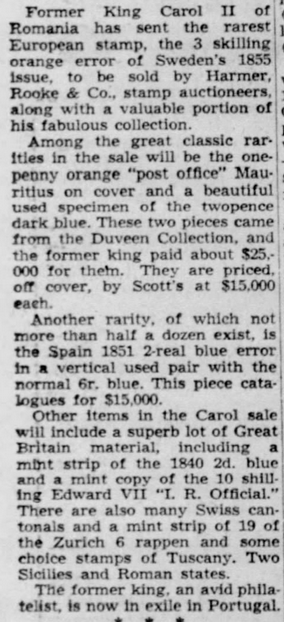
2:04 Heiden knows what the "three skilling orange error" is and that it is indeed held by an exiled king. Cole is drawing from real life here. See the article in Wikipedia https://en.wikipedia.org/wiki/Treskilling_Yellow and also see the news clipping below as the actual stamp was put up for auction the year following the program.

4:00 Arthur finds the dead stranger in the hallway. It's first thought of as suicide, but it turns out to be murder.

5:58 They make a point that the murdered man had an "interesting" and "nice face." That's the power of radio. Everyone can imagine what comprises an "interesting face" and a "nice face."

6:33 They have great fun with the word "philately" and that Casey doesn't know it; the rest of the show he makes a point of using it and makes it seem like he knew the word all along when he later talks to Logan (15:28).

9:00 Mr. Nestorcamp is another Blue Note customer, mentioned by name by Ethelbert, but no dialogue.

10:50 Ethelbert recognizes the victim as Angelo Carfora. The last time Ethelbert recognized a murder victim was in 1949-03-10 Scene of the Crime when he was taking his correspondence course in detection. Ethelbert is totally befuddled by Ann's kiss on the cheek for helping with the case.

11:42 Before they can get into Carfora's house, it bursts into flames... and 11:52 someone's shooting at Casey! Casey gets knocked out by the gunman, and so does Ann! They were knocked out in last week's episode, too! Radio detectives do not have a concussion protocol, it seems. But after the mid-show commercial, they're both okay.

15:55 They learn that it was Arthur's gun that Casey found at the fire.

17:50 During the conversation with Robert Heiden, he mentioned that Carfora had sent him stamps before and asked if they were authentic. All of them were forgeries, except for the recent time when he brought him a "postmaster provisional." That's a real thing; read about it at Wikipedia  https://en.wikipedia.org/wiki/United_States_postmasters_provisional_stamps

18:12 Heiden is told that the murder victim was Carfora... he had never met him though he did business with him through the mail.

18:53 Heiden is shot! Did Arthur kill him?

22:00 It's sibling jealousy that drove the incidents... Horace killed Carfora because Arthur could get away with all kinds of misbehavior. We learn the details at the Blue Note.

25:30 Casey explains that Carfora was a skilled engraver who was trying to create replicas of collectible stamps. He was sending Heiden his work because as a collector of renown, he could spot fakes. In all those iterations, Carfora was perfecting his techniques. Horace got the idea to sell Carfora's work to other collectors not as known replicas, but as forgeries. Horace tried to frame Arthur for the deaths of Carfora and his father.

You get a sense of lusher orchestra arrangements under Feuer. He had previously worked on Escape and was probably influenced by Spier and Robson's use of music on Suspense and other Hollywood productions. The Bleyer arrangements had an obviously different sound.

Casey 49-08-11 301 The Death of a Stranger UPGRADE.mp3
Degoo https://app.degoo.com/share/0I3THTrXWhRQE8
hubiC http://ovh.to/nprjQeg

1949-08-11 Wisconsin State Journal
Casey, Crime Photographer - Page 6 1949-179

About five months after the broadcast, the exiled king who owned the Swedish stamp in question put it up for auction.

1950-01-29 Pittsburgh PA Press
Casey, Crime Photographer - Page 6 1950-135

1949-08-04 Sell-Out (first Philip Morris show)

Sell Out is the first of the Philip Morris sponsored Casey shows. The program has a bit more action, seems to have more acted violence rather than the way it was handled on the Toni shows where it was usually referred to it in the past tense. The shows are generally more exciting than the Toni run. Plotlines become a little more complex again, in line with the A-H series. This is a shift back to its original broader target audience.

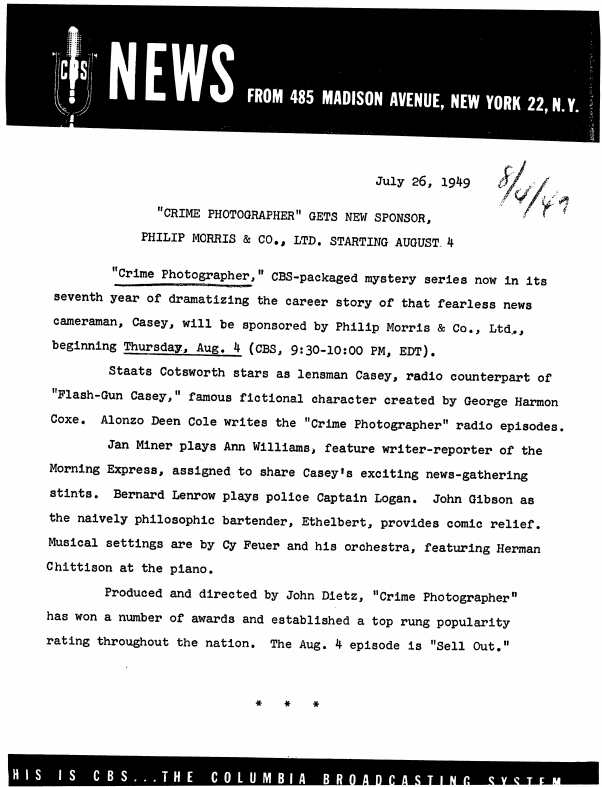
1949-07-26 CBS Press Release
They didn't let the body get cold: the date of the release is two days before the final Toni episode. At least when Anchor-Hocking ended, they waited until the day after the final broadcast.
Casey, Crime Photographer - Page 6 1949-163

The 12 unique PM-sponsored episodes in circulation are mainly available as AFRS versions. We only have two episodes that are network broadcasts (excluding 3 repeat broadcasts).

The episode begins with the legendary "Call for Philip Morris" by "the living trademark" Johnny Roventini. Read about him at https://en.wikipedia.org/wiki/Johnny_Roventini

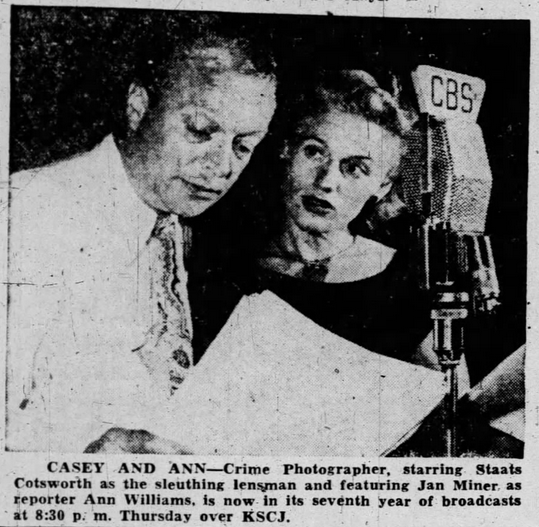
New sponsor, new announcer: this time it's Ken Roberts. It's a little disconcerting as a collector to hear him because his voice is so associated with his announcing work on The Shadow, which is often the first series many of us listened to as newbie collectors.

New sponsor, new music: Archie Bleyer is gone, replaced by Cy Feuer, very well respected for his musical abilities. The show's music has a quite different style.
http://www.radiogoldindex.com/cgi-local/p4.cgi?ArtistName=Feuer,%20Cy&ArtistNumber=09784
Bleyer was more of a band, with emphasis on the horns dominating the sound. Feuer was smoother, still a big orchestra but more subtle and more sophisticated -- he did a lot of Broadway work. Collector and musician David Gibbs commented to me "Bleyer tended to use fanfares during the musical bridges, while Feuer tended to be more subtle attempting to convey more emotion in the openings and musical bridges. It sounds as if, perhaps, Feuer may have had a slightly larger orchestra to work with. This would not surprise me given the deep pockets that big tobacco had. Fauer's bridges tended to fit the tone and pace of the story, while Bleyer seemed to be relying on more consistent bridges regardless of the story.Perhaps Feuer was previewing his own move into theatrical programming in his approach. Bleyer tended to be more 'in your face' and this could be seen in his work with [Arthur] Godfrey and his own 'solo' career with songs such as Hernando's Hideaway."

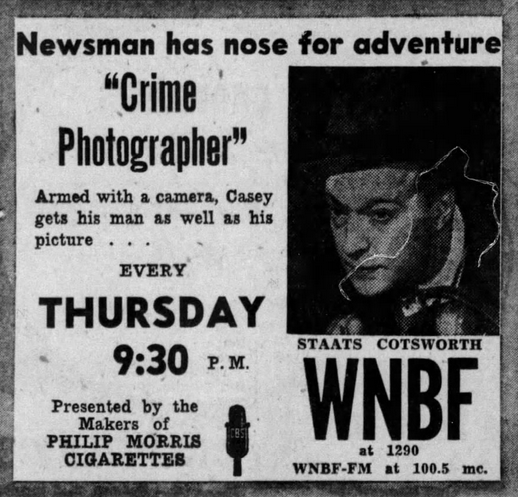
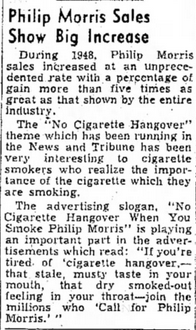
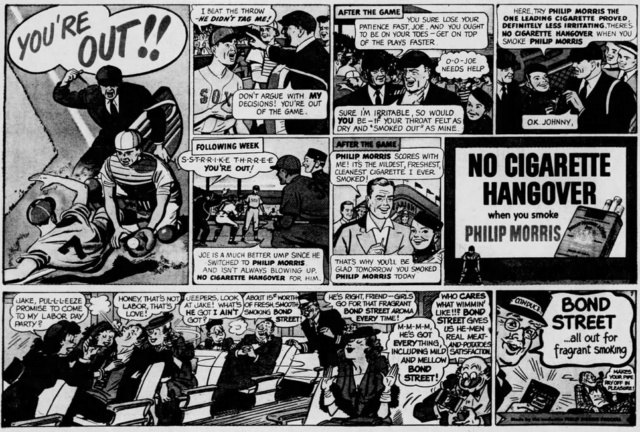
Philip Morris' marketing differentiation focused on "cigarette hangover." It worked well for them, increasing sales. At the end of this post are more details including two comic strips about the concept that appeared in newspapers.

ADC continuity notes... (typos included)
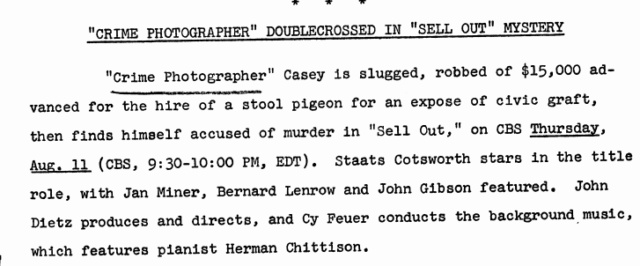
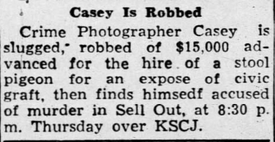
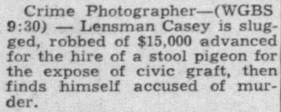
Them State-O-Mainers say "bawth" for bath - and it's a good thing for Casey that they do or there's no telling what might have happened to our Crime photographer in this script. Talbot, the Morning Express' new assistant manager is listening to Casey try to sell him on the idea of paying $15,000 for an exclusive story - a documented expose of civic corruption. Casey goes on to explain that a man in the confidence of one Harry Fitzroy, a gang leader, will supply him with evidence that a number of important city officials receive a regular pay-off from Fitzroy - and for this information the "confidence man" wants $15,000. At first Talbot can't be sold on the idea but finally Casey convinces hill that it's worth following up - and Talbot turns over $15,000 in cash to Casey. Casey and Ann set out to meet said confidence man and they meet up with all kinds of trouble. Casey gets slugged - their confidence man is found dead - and the 15 grand disappears. A local neighbor identifies Casey as the man who came to his door and who was seen lurking near the scene of the crime shortly before the murder. Casey swears he just arrived and he's never seen the neighbor before this. For awhile it looks as if Casey is pretty much involved in what is going on - but the old neighbor's faint recollection of the manner of speech used by the man who came to his door throws light on the real suspect and absolves Casey of any wrong-doing.

$15,000 is $180,000 -- it's an outrageous amount. Cole continues the policy of pecuniary puffery to make listeners gasp and pay attention. That $15,000 is 4.5x average US household income for 1950.

Is this an episode where Casey is based in Boston? It's a reasonable trip to Portland, Maine along Route 1 (Interstate 95 did not exist yet).

Bath, Maine is a city along the coast. https://en.wikipedia.org/wiki/Bath,_Maine
Cole put in his notes that it sounds like "Bawth" but my experience has been that it sounds more like "Bahth"

1:33 Ethelbert calls Walter for coffee for Ann (no response). The coffee does eventually get delivered, but all we hear is the cup and saucer being placed on the counter.

2:26 Cole lays the groundwork for the solution: a new Morning Express employee, Talbot, the assistant editor. He has Maine accent, which is important to the story, and also the stereotypical prudent skepticism of spending money.

3:04 Burke has lines again! He pleads the case for the money. Casey won't reveal his source, but Talbot demands full disclosure. We later learn it's because Talbot is a devious person and he wants to know who the informer is. It turns out to be "Squint Hummel." Casey then gives specific details of when, where, and how he will be meeting Hummel at at McBurney's Point. At this moment in the story, Casey has given enough Talbot enough information that he has essentially written Squint Hummel's death warrant -- but he does not realize that until much later.

Inside joke played by Cole: McBurney's Point is part of human anatomy! https://en.wikipedia.org/wiki/McBurney%27s_point

7:35 Both Casey and Ann are knocked out! The slowly return to consciousness. The money was stolen, and they think Squint double-crossed them.

8:30 They look in the car: Squint Hummel has been shot, in the head and two in the chest! Casey realizes that he's been framed as part of the shooting.

10:15 They realize that a neighbor (Mosley) to the property is walking near them... Casey mis-recognized, a result of the plan to frame him. Someone wearing clothes like Casey had gone to the neighbor before, but he never saw Casey's face. Key item: the person the neighbor spoke to sounded like a native Mainer (a "Bahth" man), but Casey doesn't. This does not really click on Casey until later when he starts to figure out everything that happened.

12:48 The officer who had started to interrogate Casey and Ann is shot by some badly rendered gun shot sound effects! The neighbor runs away... and they're asked to turn over the envelope they were getting from Squint. Casey gets knocked out again! The gangsters talk about getting a tip about what Casey and Ann were doing, and she told them they were double-crossed, too.

16:58 Casey regains consciousness and gets them to stop the car and knocks out the two thugs. Casey takes their car and leaves with Ann... he's figured out the crime and describes how they were framing him.

18:50 Ann says "we can't stay on the lam for very long." Casey says "you, at least, aren't the type," admitting Ann's ingrained honesty and goodness, much different than his own, much rougher personality.

20:00 Casey calls Logan and asks that Mosley be released from custody as a witness. Logan grudgingly agrees. Mosley says he could have sworn that Casey was a "Bahth" man, the second time he has said it, and now Casey fully understands the story.

21:45 Casey realizes what's happened... and it's all because of the Maine accent!

22:36 Talbot walks into Mosley's home. We realized that Mosley called Talbot, at the urging of Casey, and told him to come because he had information about Hummel's murder. Talbot pulls his gun on Mosley because he knows that he can be blackmailed with what Mosley knows. Logan jumps into the scene quickly and shoots Talbot in his gun hand.

In the Blue Note epilogue, we learn that Talbot had big plans to blackmail gang leader Fitzroy and others for more money than the $15,000 from his own newspaper. And, he would have let the gangsters kill Casey and Ann to cover up the entire scheme.

Bernard Lenrow remains excluded from the closing credits. He was still working on Molle Mystery Theater as "Geoffrey Barnes." If you want to see Lenrow, he appears in this episode of TV's Tales of Tomorrow as a lawyer, about 15 seconds into the video https://youtu.be/KuColILe3zM

We don't know if Cole picked the name Hummel because of the popular-at-the-time German porcelain figurines that soldiers brought back from their service time in post-war Germany. Writers grabbed names from streets, products, neighbors, and other inspirations, even obscure names from anatomy as we learned in this episode, while they were writing. Cole was always good at silly nicknames. "Squint" usually meant someone who wore glasses. In the popular TV series Bones, it referred to lab technicians who were always looking into microscopes.

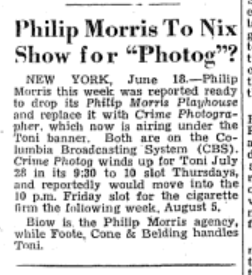
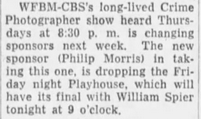
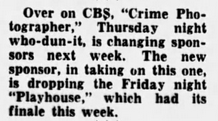
CBS had an internal mix-up as to when certain scripts would be used for the first two weeks of the Morris sponsorship, as can be seen from these press releases.

CBS Press Release, likely issued 1949-08-01 or shortly thereafter
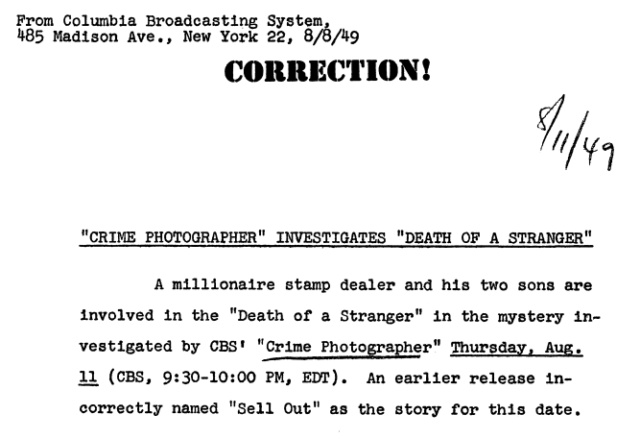
Confusion in the office: Death of a Stranger was announced at some as the first episode, with Sell Out being presented the week after.
Casey, Crime Photographer - Page 6 1949-165

1949-08-08 CBS Press Release
Now they got it right.
Casey, Crime Photographer - Page 6 1949-164

Casey 49-08-04 300 Sell-Out (Philip Morris sponsor) UPGRADE.mp3
Degoo https://app.degoo.com/share/wcEAcQKGQFlg8j
hubiC http://ovh.to/D4sHFa

1949-07-31 Port Huron MI Times Herald
Casey, Crime Photographer - Page 6 1949-166

1949-08-04 Cincinnati OH Enquirer
Casey, Crime Photographer - Page 6 1949-167

1949-08-04 Hagerstown MD Herald
Casey, Crime Photographer - Page 6 1949-168

1949-08-04 Minneapolis MN Star
Casey, Crime Photographer - Page 6 1949-169

1949-08-04 Rochester NY Democrat & Chronicle
Casey, Crime Photographer - Page 6 1949-170

1949-08-07 Sioux City IA Journal
Casey, Crime Photographer - Page 6 1949-171

1949-08-11 Miami FL News
Casey, Crime Photographer - Page 6 1949-172

* * * * * * * * * * * * * * * * * * * * * * * * * * * * * *

These are news items and ads related to Philip Morris and their sponsorship decision.

1949-02-10 Jefferson City MO Daily Capital News
The new marketing strategy is working
Casey, Crime Photographer - Page 6 1949-173

Billboard 1949-06-25
The news broke in Billboard that PM would be leaving the William Spier version of Philip Morris Playhouse. Casey was a highly rated program, probably better than PMP, and a lot less expensive to produce.
Casey, Crime Photographer - Page 6 Billbo22

1949-07-03 Lincoln NB Star
Casey, Crime Photographer - Page 6 1949-174

1949-07-29 Indianapolis IN News
Casey, Crime Photographer - Page 6 1949-175

1949-07-30 Davenport IA Daily Times
Casey, Crime Photographer - Page 6 1949-176

These are examples of their marketing campaign outside of radio. Remember, there's really no television advertising possibility. These panels would have become TV ads at a later time, but using the comic format lets them tell an extended story in a unique way. When ad agencies plan their TV commercials, they make storyboards that look almost like comic strips/

1949-04-10 Boston MA Globe
Casey, Crime Photographer - Page 6 1949-177

1949-08-21 Richmond VA Times Dispatch
Casey, Crime Photographer - Page 6 1949-178

1949-05-19 Cupid Is a Killer

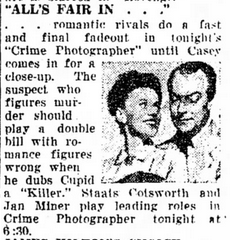
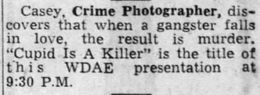
Cupid Is a Killer is a script originally written for the sustained era of the Casey series, but it fits perfectly for the softer and more romantic undertones for the Toni target audience. It's a good and entertaining script, in comic book style, but not one of the series' best.

This is the latest episode of Toni run that is in circulation. Of the five surviving, The Wolverine was the only "traditional" script. The Toni scripts are not all that exciting, but Scene of the Crime offered more of Ethelbert than usual in an entertaining way, and Cupid is a Killer is definitely entertaining because the romantic subplot borders on screwball comedy. Scene and Cupid are still not at the best level of the Anchor Hocking run, but they each have some worthwhile moments.

ADC continuity notes...
Casey demonstrates to a love-smitten gangster the error of bumping off the opposition to clear the road for romance. When a man is murdered by a rifle bullet, the police and Casey, set out to break the air-tight alibi of Bat McCoy, known admirer or the victim's pretty wife. A trap baited with honey, a little more cooperation than usual the detectives on Capt. Logan's force, and another murder motive is set in motion - with dramatic and surprising results for everybody.

These are the notes regarding the original 1945-10-20 broadcast...
A killer named Bat McCoy shoots the piano player in his night club in order to have a free field with the widow, Valeria[sic], a friend of Ann and Casey. Kansas, a detective on the case, falls for Valerie and Casey and the police plan a trap whereby McCoy will try to kill the detective. Kansas and Valerie have a fight and Casey substitutes for him. The killer is trapped and after much wrangling between Casey, Ann, Valerie and Kansas, everything is straightened out and Kansas and the widow become engaged.

Casey's knowledge and personal familiarity with his city's criminals is brought into play in this episode.

The Bat McCoy characterization in the episode is very amusing as it is a street thug trying to sound sophisticated and gracious in eulogizing the deceased.

1:08 Ethelbert is bringing lemons up to the bar. Where's Walter?

8:40 The fascination that Kansas has with the Valerie begin at this point. He is absolutely smitten. He even asks Casey for a privately printed photo of her. It's not stalking, because Kansas is portrayed as having pure intentions and wanting the best for her. But he is messing with the object of a gangster's affections... so there is some danger ahead.

10:30 Throckmorton (Kansas) and Ethelbert meet and have comments about each others names. A brief and funny moment.

19:00 Kansas does not like Casey's plan and quits the police! They weren't expecting that, but it leads to the marvelous joke on Casey that makes the episode somewhat endearing. Logan keeps the secret and lays it on pretty thick to get Casey in trouble at around 22:45 and it all blows up on Casey starting at 24:00. The scene is well-done and worth a good and happy smirk if not a chuckle. This kind of scene is what makes the series endearing despite its occasional problems.

25:55 At the Blue Note, Casey is all discouraged, saying that "Ann is off him for life." It does have a very happy ending, and Kansas and Valerie are engaged, but not before keeping the joke going on Casey.

Bat McCoy gets a floral arrangement for the casket that looks like a piano. Don't believe it can be done? Look at this...
https://www.viviano.com/store/itemdetail.asp?id=1996

Bat McCoy used a .30-30 rifle. The history of the Winchester rifle can be found at https://en.wikipedia.org/wiki/.30-30_Winchester

"Throckmorton" as a name comes from England. There's a different radio character with that name, but I just can't remember which character it is :)

Casey 49-05-19 289 Cupid Is a Killer (Repeat of # 112 -- latest circ Toni) UPGRADE.mp3
Degoo https://app.degoo.com/share/u6ZjrKc1Ft5Q9H
hubiC http://ovh.to/ves9yVN

1949-05-19 Bakersfield CA Californian
Casey, Crime Photographer - Page 6 1949-161

1949-05-19 Tampa FL Times
Casey, Crime Photographer - Page 6 1949-162

1949-05-05 The Wolverine

The Wolverine is a Toni episode that is more like the style of the A-H series. Many of the Toni episodes had a second plotline that dealt with relationships, but this episode is flirt-free. It's a better than average episode with a comparatively simple storyline. It is an entertaining comic-book detective style plot with some amusing overacted thugs and upper class characterizations of a competitive reporter and a college professor that clearly place Casey and Ann as ordinary people. Cole's casting of suspicion on the reporter, Foster, is much too obvious and by now we know how typical this is of the Cole's strategy, but making him the hero is chuckle-worthy in the end.

This is another episode where Cole uses the theme of a psychologist studying criminal behavior by rubbing shoulders with them, like the popular 1938 movie The Amazing Dr. Clitterhouse. Cole also used it in 1947-08-07 Death In Lovers Lane.

ADC continuity notes...
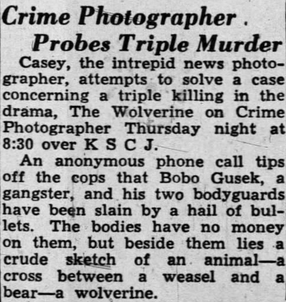
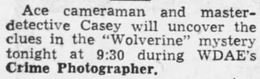
Casey attempts to solve a case concerning a triple killing in this script titled "The Wolverine". An anonymous phone call tips off the cops that Bobo Gusek, a gangster, and his two bodyguards, have been slain by a hail of .45 bullets. The bodies have no money on them, but beside them lies a crude sketch of an animal - a cross between a weasel and a bear - a wolverine.

Cole could have gotten the name "Bobo" from Bobo Newsome, a major league pitcher at the time.

4:10 This is one of the few episodes where the city desk editor, Burke, has a speaking role.

9:05 Competitive reporter Foster says he will make pencil sketches from the photos he took. Is he the Wolverine? Cole plays up the class difference between newspaper readership. In New York, it was the NY Times compared to the Daily News, in Boston it was the Globe compared to the Herald. The NY Daily News may have been what Cole had in mind as the model for Casey's employer The Morning Express as it was promoted as "New York's Picture Newspaper," using more photos than its rivals.

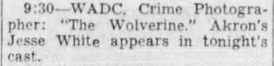
One of the newspaper clippings identifies Jesse White appearing in the episode. He appears at about 12:00 as "Manny," one of the members of gangster Joe Schuster. He is not credited in the program; it is likely that White's agent or family reported his appearance to the newspaper as a "home town kid does good" story. White was a well-known bit player for decades but became well- and affectionately known for being the lonely Maytag repairman in commercials that highlighted the product's reliability.
https://en.wikipedia.org/wiki/Jesse_White_(actor)

15:25
The mid-show Toni commercial is used to update listeners who may have lost track of the story or tuned in late.

Dr. Avon, the professor who is studying the criminals, is another way Cole plays out class differences. College professors were "mysterious" to most of the public in that only a small percentage of the population went to college, even for just a few courses. Psychology was also a strange and mysterious topic that radio writers could always weave into their stories to capture listener interest. There was a sense that psychologists knew things others didn't and had insights into people that could be used to manipulate them.

22:32 Cotsworth has some odd pauses here. Not sure what was going on, perhaps he had to swallow to clear his throat or something, or if it was supposed to be a pause to indicate he was thinking.

24:48 Dr. Avon is the Wolverine. He walks into Casey and Ann's discussion about his "invisible ink" notes written between the lines of his diary. This is still a popular kid's home science project that uses lemon juice. http://www.sciencekids.co.nz/experiments/invisibleink.html

24:51 "Yeah, we see the .45 in your hand, Doc" is the way Cole tells us there's a gun in the scene.
Foster saves the day by hitting Avon in the head with his... camera! Really? Cameras were pretty bulky in those days, and it could be done. The cameras that news photographers used were heavy and durable. Studio photographers did not place the same kind of demands for portability and rugged handling on their equipment.

Casey 49-05-05 287 The Wolverine.mp3
Degoo https://app.degoo.com/share/Hx4zO9Qst07z5Y
hubiC http://ovh.to/wSogQaA

1949-05-01 Sioux City IA Journal
Casey, Crime Photographer - Page 6 1949-158

1949-05-05 Akron OH Beacon Journal
Casey, Crime Photographer - Page 6 1949-159

1949-05-05 Tampa FL Times
Casey, Crime Photographer - Page 6 1949-160

* * * * * * * * * * * * * * * * * * * * * * * * * * * * * * * * * * * * * * * *
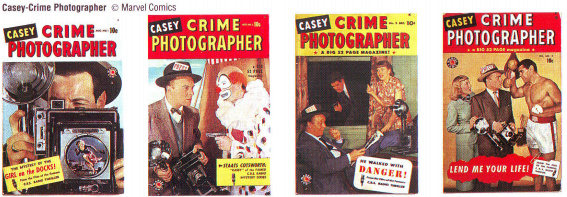
At 27:50 the availability of the first issue of the Casey comic book is announced. It was not successful, lasting just four issues.

Casey, Crime Photographer - Page 6 All_4_10